




Real-estate titan, 94, ensures Holocaust is never forgotten
|
Eugene and Emily Grant visit the Gates of Remembrance in White Plains. The gates are part |
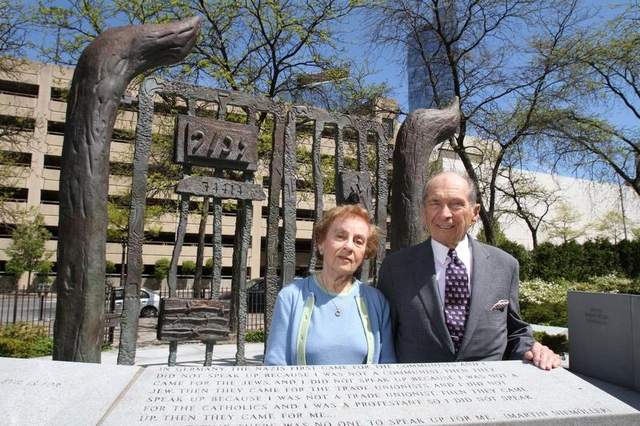
MAMARONECK — As a fighter pilot whose unit teamed up with the U.S. Third Army to liberate 21,000 prisoners from the Buchenwald concentration camp on April 11, 1945, Eugene Grant had the chance to be part of a historic event.
But he didn’t take it.
The 94-year-old real-estate heavyweight (he sold his majority stake in the St. John’s Terminal Building in New York City earlier this year for about $250 million) has seized on many opportunities. But flying out to Weimar, near Buchenwald, wasn’t one of them.
“My fellow officers went, but I couldn’t. I don’t know why,” said the chairman emeritus of the Holocaust & Human Rights Education Center in White Plains who donated $250,000 to the nonprofit last month.
While that was the largest gift the center has received in its 20-year history, it is not the largest amount Grant and his wife, Emily, have given to various institutions. On Thursday, the Purchase College Foundation (Emily Grant sits on the board) announced that the couple had donated $2.5 million for student scholarships.
Emily Grant offered insight as to why her husband opted out of the Buchenwald mission.
“He was a young man,” she said,sitting in the backyard of their Mamaroneck home overlooking Long Island Sound. “Maybe he wasn’t prepared to face it.”
That missed opportunity bothered him for decades, he said.
|
Emily and Eugene Grant are photographed at their home in |
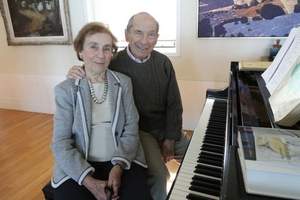
“I felt somewhat burdened with that decision, given the enormity of the Holocaust and the liberation,” said Grant, a grandchild of Russian Jewish immigrants and a high-profile philanthropist who sits on the boards of the Metropolitan Opera and the Jewish Museum of New York. “The scale of the horror was so vast, that for years I had in my mind that I had to do something.”
That something translated into the establishment of the Westchester Holocaust Commission in 1992, the predecessor of the center that created the Garden of Remembrance, a memorial and sculpture garden next to the Westchester County office building in White Plains and established under then-County Executive Andrew P. O’Rourke.
Millie Jasper, the executive director of the center, whose annual operating budget is $400,000, said the capital grant was a shot in the arm to build up programs.
“It’s a sizable donation which will allow us to bring back programs,” Jasper said. “Our lecture series has been on hiatus, and we are hoping to bring that back.”
A rededication of the memorial will take place June 9.
Eugene Grant was born in Manhattan’s Hell’s Kitchen. He received a law degree from Columbia University before joining the Army Air Forces. After the war, he entered the real-estate development business, following in his father’s footsteps.
In 1950, he capitalized on the postwar housing shortage, buying land and creating a small housing development in on Central Drive West in Briarcliff Manor for returning veterans. As his business grew, the Grants moved from Manhattan to Mamaroneck in 1955 to raise their three daughters, and involved themselves in many philanthropic and civic organizations in the county.
Emily Grant joined the board of the Purchase College Foundation in 1969, serving 18 years as chairwoman; she served as a president of the Mamaroneck League of Women Voters and was a founding member of the Emelin Theater in Mamaroneck. Last month, the couple made an undisclosed donation to kick-start a $5 million fundraising campaign for ArtsWestchester, said Janet Langsam, the nonprofit’s chief executive.
Standing at the Gates of Remembrance, a bronze sculpture that is the centerpiece of the garden in White Plains, Eugene Grant talked about the importance of remembering the Holocaust.
“As the memory recedes, the consciousness recedes and the emotionality recedes,” he said. “But it is important to keep the memory alive, so it never happens again.”
Eugene Grant may have missed witnessing the liberation of the camps, but he has closely followed Nobel laureate and Auschwitz survivor Elie Wiesel’s exhortation: “When you listen to a witness, you become a witness.”
The consummate businessman, who continues to commute to his Park Avenue office each day (“If you love what you are doing, is it work?”), makes it a point to meet up with Ernest W. Michel, an 89-year-old Auschwitz survivor, once a week.
“He picks me up in his car, and we go for lunch,” said Michel, whose sixth-grade teacher in Mannheim, Germany, called him aside in 1936 to tell him that he could no longer attend school. At 16, Michel was sent to his first concentration camp. Surviving several Nazi camps, he escaped from Auschwitz before the end of World War II at the age of 23.
“Eugene is a big contributor to the Holocaust survivors,” said Michel, who’s known Grant since the 1970s. “He’s a unique guy who doesn’t talk much about what he does, but he always wants to do something for the victims of the Holocaust.”
View Original Article
Copyright © 2013 www.lohud.com. All rights reserved.